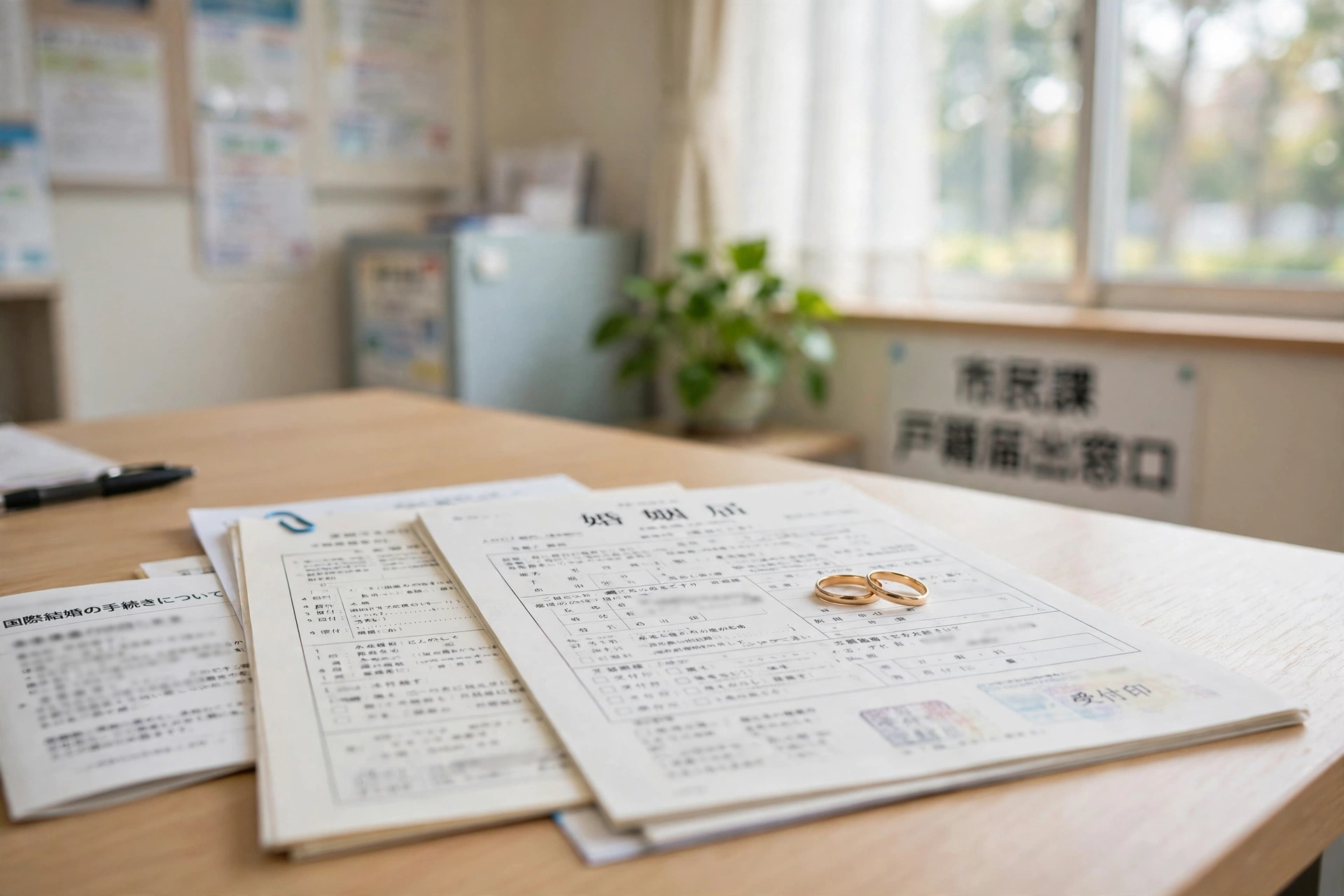
“We would like to submit our marriage registration — what documents does my foreign-national partner need?”
At a city office counter, a couple asks this question, cannot get an answer on the spot, and has to gather the documents and come back another day — stories like this are not uncommon in consultations about international marriages. If both partners are Japanese, a marriage registration form and a family register transcript are almost all you need. But when one partner is a foreign national, things become a little more complicated, because a document certifying, under the law of the partner’s country, that the partner is in a position to marry is required — and some countries do not issue such a certificate.
Moreover, having your marriage registration accepted is not the end of the story. If you neglect to file in your partner’s country, a discrepancy remains: “a married couple in Japan, but single in the partner’s country.” And if, unfortunately, the marriage ends in divorce, international divorce is explained in detail in a separate article, “International Divorce Procedures and Residence Status After Divorce”.
This article explains, in order, the “notifications and procedures” side of an international marriage: how to submit the marriage registration, filing in your partner’s country, and a child’s birth registration and nationality. The residence status that allows a foreign spouse to live in Japan (the spouse visa) is explained in detail in a separate article, “Residence Status After an International Marriage”.
■ Two hurdles in the procedures for an international marriage
It is easier to organise the procedures for an international marriage if you think of them in the following two stages.
The first is “the procedures to make the marriage legally effective.” When you submit a marriage registration to a municipal office and it is accepted, the marriage becomes legally effective in Japan, and the fact of the marriage is recorded in the Japanese spouse’s family register.
The second is “the procedures to live together in Japan.” If the foreign spouse is overseas, you apply for issuance of a Certificate of Eligibility; if the spouse is already living in Japan under another status of residence, you apply for permission to change the status of residence. Only once permission as “Spouse or Child of a Japanese National” is granted can the spouse live in Japan as your spouse.
Even if the marriage registration is accepted, a spouse visa is not issued automatically. Conversely, in the visa screening, you will be asked again whether you will really live together as a married couple. Please first understand that these are two separate procedures.
This article deals mainly with the notifications and procedures on the first side — “the procedures to make the marriage legally effective.” The second, residence status, is explained in detail in a separate article, “Residence Status After an International Marriage”.
■ Documents and steps for submitting a marriage registration in Japan
When submitting a marriage registration in Japan, the Japanese partner prepares the marriage registration form and a family register transcript (certificate of all matters). What is required of the foreign partner is the “Certificate of Legal Capacity to Contract Marriage.”
The Certificate of Legal Capacity to Contract Marriage is a document issued by a competent authority of the foreign spouse’s home country, such as its ambassador or consul, certifying that the spouse meets the requirements for marriage under the law of the home country (such as having reached the marriageable age and being single). When a municipal office accepts a marriage registration, it examines, on the basis of this certificate, whether the foreign partner satisfies the requirements of their home country’s law. As a rule, the certificate is issued at the home country’s embassy or consulate in Japan. If the document is drawn up in a foreign language, a Japanese translation of the full text must be attached, with the translator’s name entered (the translation may be done by the person themselves).
The difficulty arises when the home country does not issue this certificate. In that case, a sworn affidavit — in which the person swears before a consul that there is no impediment to the marriage under the law of the home country, and which the consul signs — may be accepted as a substitute document. If even that is difficult, the requirements must be proved by combining copies of the home country’s laws, a birth certificate, a certificate of nationality, and the like. Because treatment differs greatly from country to country, it is safest to check, before submitting the marriage registration, with both the family register desk of the municipality where you will file and the embassy or consulate of the partner’s country.
A checklist for the marriage registration is as follows.
| Document | Japanese partner | Foreign partner |
| Marriage registration form | ○ (signatures of two witnesses required) | ○ |
| Family register transcript (certificate of all matters) | ○ | — |
| Certificate of Legal Capacity to Contract Marriage (+ Japanese translation) | — | ○ (issued at the home country’s embassy/consulate) |
| Identity documents such as a passport | Identity document | ○ |
| If the home country does not issue the certificate | — | Substituted by a sworn affidavit, birth certificate, certificate of nationality, etc. |
Under Japanese law, the marriageable age is 18 for both men and women. For the foreign partner, however, the requirements of the home country’s law must also be met, so care is needed if the marriageable age under that law differs from this.
Once the marriage registration is accepted, the fact of the marriage and the spouse’s name, nationality, and other particulars are recorded in the Japanese spouse’s family register. Obtaining a “Certificate of Acceptance of the Marriage Registration” after acceptance is useful for the spouse visa application and for filing in the partner’s country.
If you have any difficulties preparing the required documents or proceeding with the filings, please consult us via the Contact page.
■ Do not forget to file in your partner’s country
Even once a marriage is legally effective in Japan, the couple is not automatically registered as married in the partner’s country. In many countries, when one of their nationals marries abroad, a separate report/registration procedure in the home country is required.
If you leave this filing undone, the partner remains “single” in their own country, and in the future — when living in that country, obtaining a spouse visa for that country, or filing for a child’s nationality when a child is born — you may be treated as “not married” and the procedures may stall. In some countries, such as China, a marriage registration in Japan alone is not regarded as a marriage registration in that country, and separate procedures or certificates are required.
The same problem arises in the event of a divorce. At the time you marry, confirm with the embassy or consulate of the partner’s country how a national’s marriage should be registered, and complete the necessary filings — this prevents trouble later.
■ When a child is born — birth registration and nationality procedures
When a child is born to the couple, for a child born in Japan, a birth registration must be submitted to the municipality within 14 days, including the day of birth. If one of the parents is a Japanese national, the child acquires Japanese nationality by birth (Article 2 of the Nationality Act).
If the partner’s country also adopts the principle of nationality by descent (jus sanguinis), the child will hold dual nationality — both Japanese nationality and the nationality of the partner’s country. For a child with dual nationality, a birth filing in the partner’s country is also necessary, and you must also note that the child will eventually have to choose a nationality. The deadline for choosing a nationality is: if the person became a dual national before reaching 18 years of age, by the time they reach 20 years of age; and if the person became a dual national after reaching 18 years of age, within two years from the time they became a dual national. Also, if the child is born outside Japan, unless a notification of reservation of Japanese nationality is filed together with the birth registration, the child may lose Japanese nationality. If you are expecting a child, check the filing arrangements before the birth.
In addition, confirming early, at the embassy or consulate of the country whose nationality the child holds, the procedures for issuing the child’s passport will make subsequent procedures smoother.
For a child who does not acquire Japanese nationality because both parents are foreign nationals, the necessary residence status procedures (application for permission to acquire a status of residence) are explained in detail in a separate article, “Residence Status After an International Marriage”.
■ Frequently asked questions
Q1. I come from a country that does not issue a Certificate of Legal Capacity to Contract Marriage. Can I marry in Japan?
A. Yes, it is possible. A sworn affidavit, issued after you swear before a consul, may be accepted in place of the certificate. If even that is difficult, the marriage requirements can be proved by combining a birth certificate, a certificate of nationality, copies of the home country’s laws, and the like. Because treatment differs by country, please check in advance with the municipal office where you will file and with the embassy or consulate.
Q2. If we submit a marriage registration in Japan, will we be treated as a married couple in my partner’s country too?
A. Not automatically. In many countries, when one of their nationals marries abroad, a separate report/registration procedure in the home country is required. Without the filing, the partner remains “single” in that country, which can cause problems in the future — for example, with procedures for living in that country, or with filing for a child’s nationality. At the time you marry, confirm the method of registration with the embassy or consulate of the partner’s country.
Q3. When a child is born, what filings are required?
A. For a child born in Japan, submit a birth registration to the municipality within 14 days, including the day of birth. If one parent is a Japanese national, the child acquires Japanese nationality; if the partner’s country also follows the principle of nationality by descent, the child will hold dual nationality, so a birth filing in the partner’s country is also necessary. A child with dual nationality who became a dual national before reaching 18 years of age must choose a nationality by the time they reach 20 years of age. The residence status procedures for a child who does not acquire Japanese nationality are explained in a separate article, “Residence Status After an International Marriage”.
Information verified on: November 24, 2026 (checked against official information from the Immigration Services Agency of Japan and the Ministry of Justice)
■ Supervised by
Itsuki Kiryu (Gyoseishoshi)
Representative of Hokuto Legal Services (Gyoseishoshi). Based in Osaka, his practice centres on residence status and visa applications (Specified Skilled Worker, permanent residence, naturalisation), and also covers vehicle registration and seal fitting (Teishu member of the Osaka Gyoseishoshi Association), inheritance and will drafting, and a wide range of licences and permits. He is also involved in running a registered support organisation, supporting companies that employ foreign nationals. He explains procedures and required documents clearly, in line with each client’s individual circumstances.